We present the Unlearning Depth Score (UDS), a mechanistic metric that quantifies the depth of unlearning by measuring how much target knowledge is recoverable through two-stage activation patching. This page provides: (i) an interactive walkthrough of the UDS pipeline, (ii) a meta-evaluation comparing 20 metrics on faithfulness and robustness, and (iii) per-method benchmark results across 150 unlearned models. The results below benchmark UDS on the TOFU [12] dataset (forget10) using Llama-3.2-1B-Instruct and the Open-Unlearning [18] framework.
Method
Preparing the Input
Construct a prompt from question and answer prefix, and mark the entity span to evaluate.
A Stage 1: Baselining
Patch retain model's hidden states into the full model at each layer.
Large drops reveal layers encoding knowledge the retain model lacks.
B Stage 2: Quantification
Repeat with the unlearned model's hidden states.
Drops matching Stage 1 = erased; near-zero = knowledge intact.
C Score Aggregation
① Filter layers that significantly encode the target knowledge.
② Compute per-layer erasure ratio from the two stages.
③ Aggregate into a final score: 0 (intact) → 1 (erased).

Meta-evaluation
We evaluate 20 metrics to measure how reliable each unlearning metric is, using the Open-Unlearning benchmark framework.
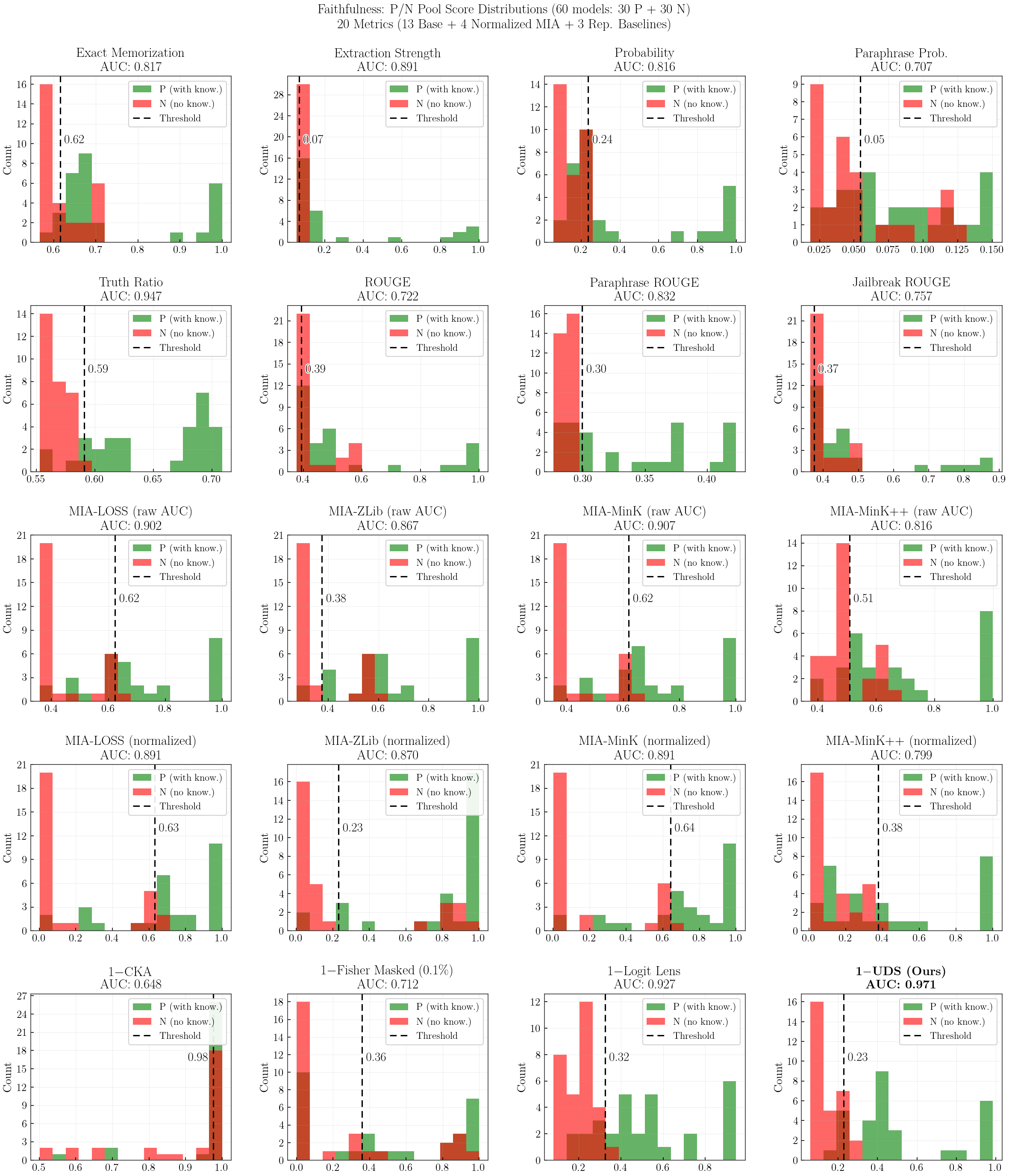
Faithfulness: How well each metric separates knowledge-present (P, 30 models) vs knowledge-absent (N, 30 models), measured by AUC-ROC.
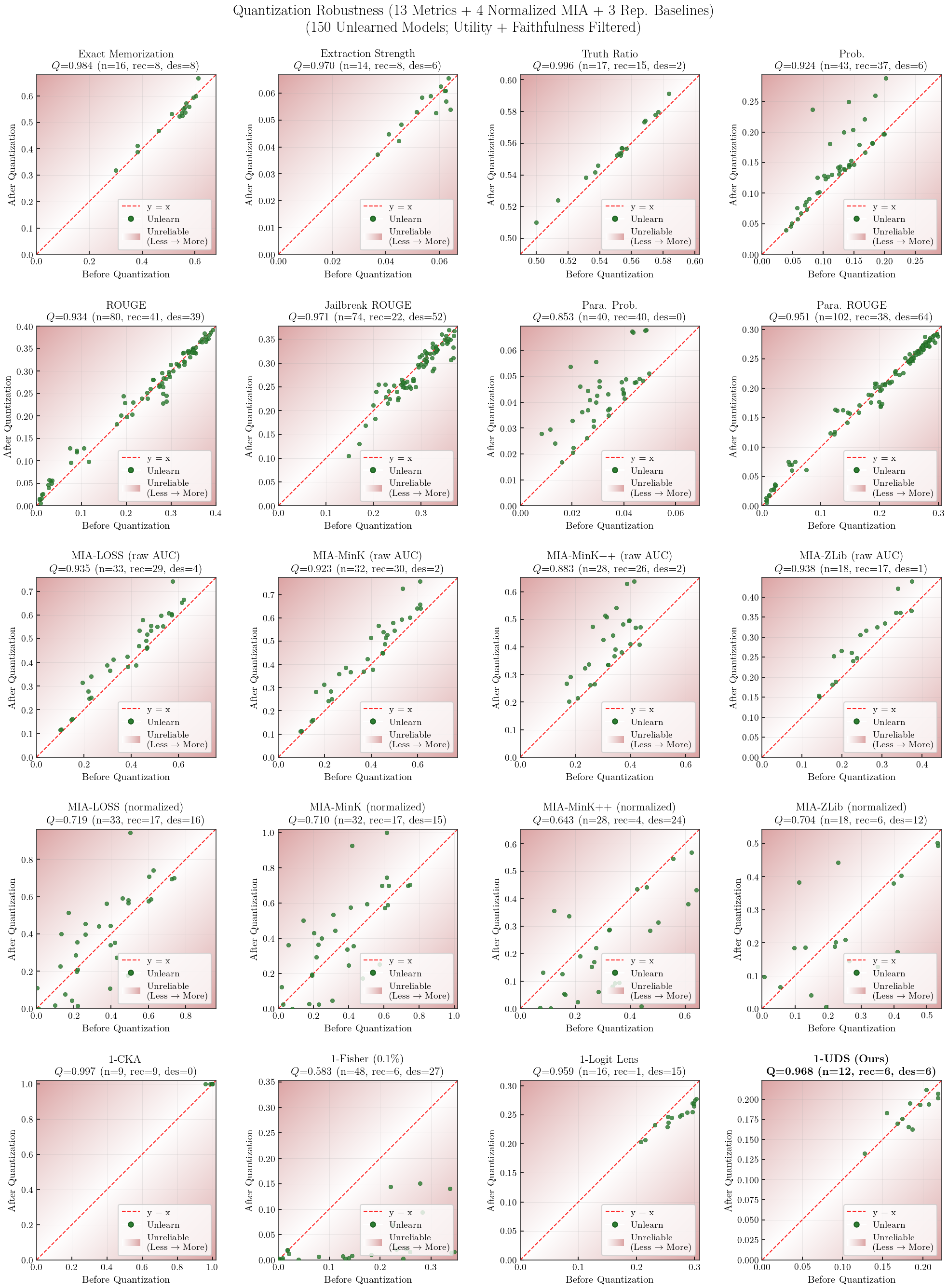
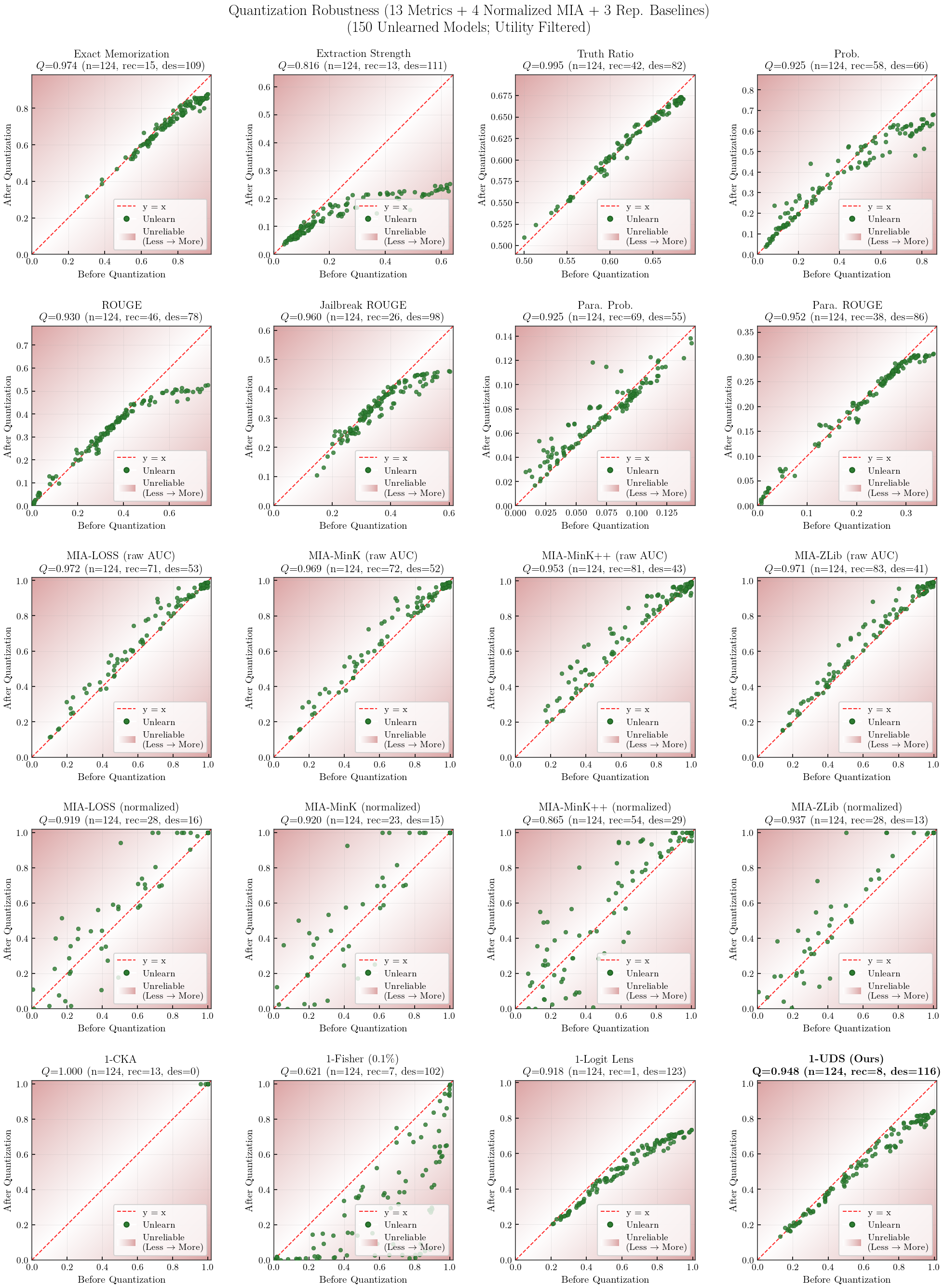
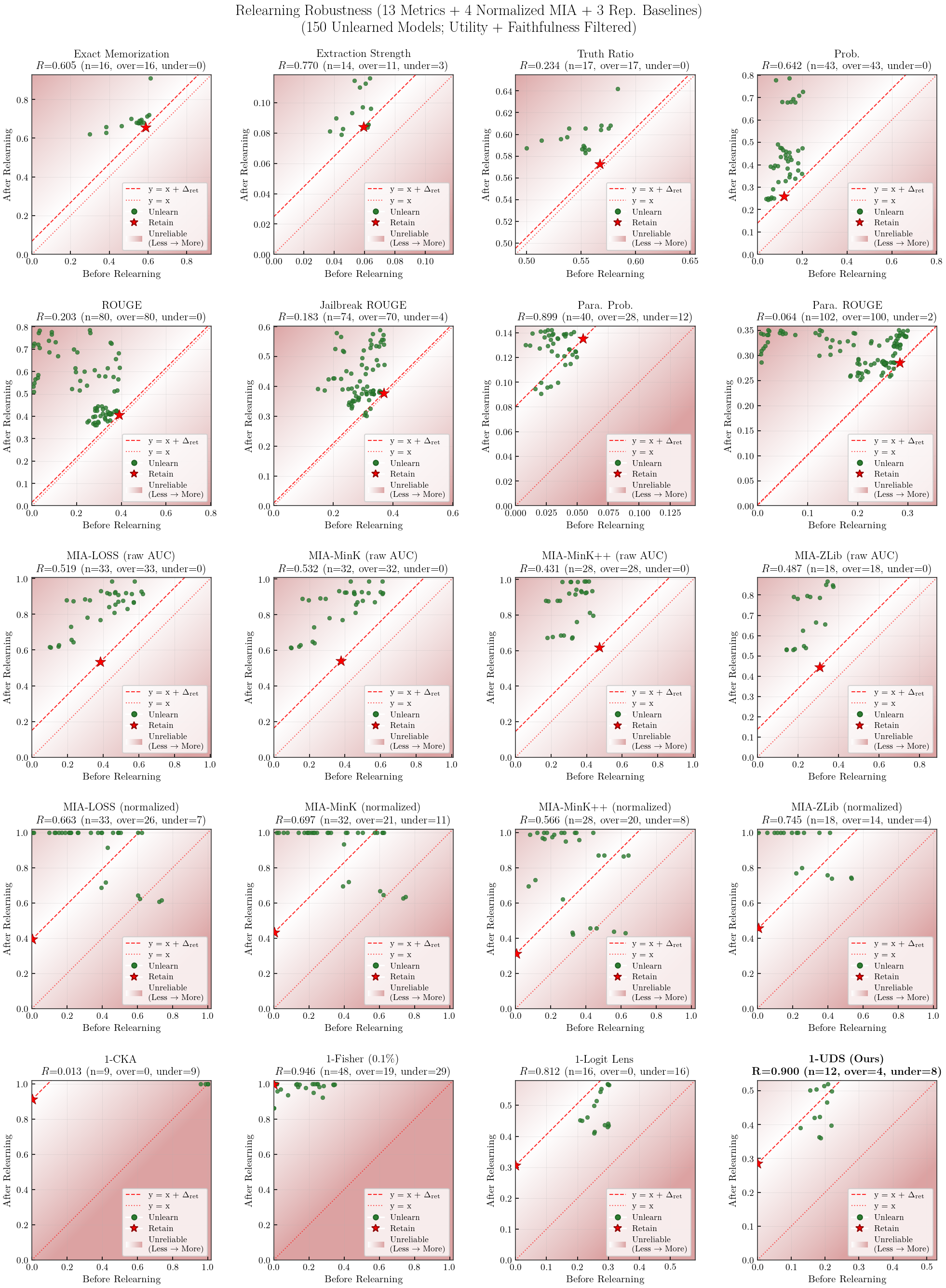
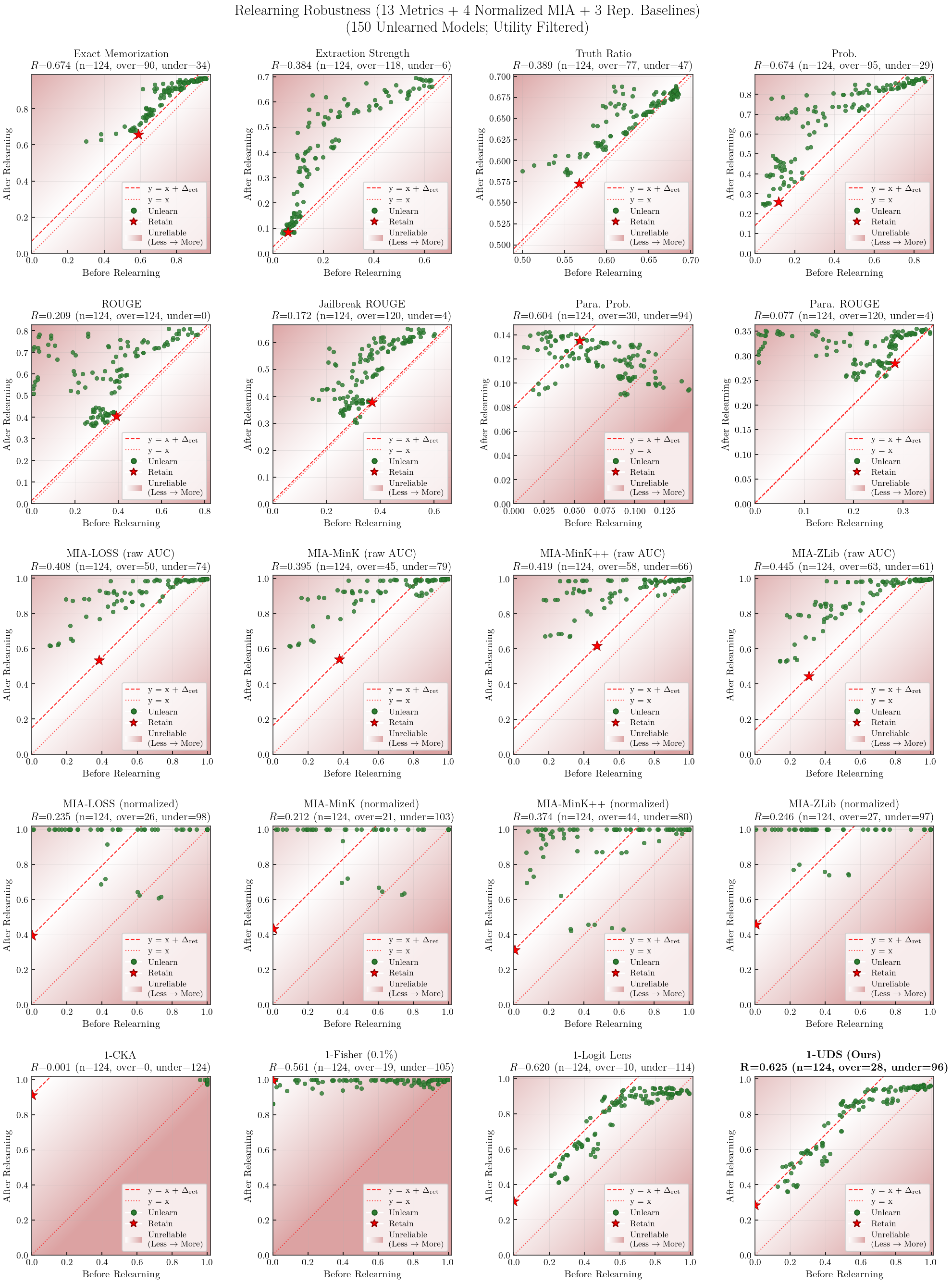
Robustness: Stability of each metric under post-hoc perturbations (4-bit quantization, 1-epoch relearning).
Formulas
Faithfulness = AUC-ROC over P/N pools (30 knowledge-present vs 30 knowledge-absent models)
Robustness = HM(Q, R) — symmetric (bidirectional)Quantization (Q) $= 1 - \dfrac{|m_{\text{after}} - m_{\text{before}}|}{|m_{\text{before}}| + |m_{\text{after}}|}$ — penalizes both recovery and destruction after 4-bit NF4 quantizationRelearning (R) $= 1 - \dfrac{|\Delta_{\text{unl}} - \Delta_{\text{ret}}|}{|\Delta_{\text{unl}}| + |\Delta_{\text{ret}}|}$, $\Delta = m_{\text{after}} - m_{\text{before}}$ — penalizes both over- and under-recovery relative to retainDirection: standard metrics use raw values (higher = more knowledge); UDS and $s_*$ are inverted ($m = 1 - \text{value}$) so that higher $m$ = more knowledge before Q/R computation.
Filtering: utility $\geq 0.8$ + per-metric faithfulness-threshold (150 models $\to$ per-metric filtered subset).
Overall = HM(Faithfulness, Robustness)
Metric Categories
ES [1] (Extraction Strength) — fraction of answer extractable via greedy decoding. $1 - k/T$, $k$ = earliest match positionEM [2] (Exact Memorization) — token-level position match ratio. $\sum \mathbb{1}(\text{pred}_t = \text{label}_t)\, /\, T$Prob — geometric mean of per-token probabilities. $\exp\!\bigl(-(1/T)\sum \text{CE}_t\bigr)$ParaProb — geometric mean of Prob across paraphrased answer variants.Truth Ratio — normalized correct vs. incorrect probability. $p_c / (p_c + p_w)$, $p = \exp(-\text{avg loss})$
ROUGE-L recall between model generation and ground-truth answer under different prompting strategies.
ROUGE — standard prompt.Para. ROUGE — paraphrased prompt.Jailbreak ROUGE — adversarial prompt (prefixed with “Sure, here is the answer:”).
Raw (4) — AUC-based:
MIA-LOSS [9] — average cross-entropy. $\frac{1}{T}\sum_t \mathcal{L}_t$MIA-ZLib [1] — loss normalized by compression length. $\ell\, /\, |\texttt{zlib}(x)|$, $\ell = \frac{1}{T}\sum_t \mathcal{L}_t$MIA-Min-K [7] — mean of bottom-$k$% log-probs. $-\frac{1}{\lceil kT\rceil}\sum_{t \in \mathcal{B}_k} \log p_t,\;\; k{=}0.4$MIA-Min-K++ [8] — standardized Min-K. $z_t = (\log p_t - \mu_t) / \sigma_t$, then Min-K on $z_t$Normalized (4, denoted $s_*$) — MUSE PrivLeak-style rescaling using retain as anchor [10]:
$\text{normalized}_* = |\text{AUC}_{\text{model}} - \text{AUC}_{\text{retain}}|\, /\, \text{AUC}_{\text{retain}}$
$s_* = 1 - \min(\text{normalized}_*,\; 1)$ (inverted; 1.0 = erased, 0.0 = large deviation from retain)
sLOSS · sZLib · sMin-K · sMin-K++
CKA [3] — representational similarity via kernel alignment, normalized against the full–retain anchor per layer.$\text{erasure}_l=\text{clip}\!\left(\dfrac{\text{CKA}(H_{\text{unl}},H_{\text{ret}})_l-\text{CKA}(H_{\text{full}},H_{\text{ret}})_l}{1-\text{CKA}(H_{\text{full}},H_{\text{ret}})_l+\epsilon},\,0,\,1\right),\;\;w_l=1-\text{CKA}(H_{\text{full}},H_{\text{ret}})_l,\;\;\text{score}=\dfrac{\sum_l w_l\cdot \text{erasure}_l}{\sum_l w_l}$
Logit Lens [4] — decodes each layer’s hidden states through the full model’s frozen decoder (LayerNorm + lm_head) to measure decodable knowledge per layer.$k_{m,l} = \text{logprob}(\text{entity}\mid H^l_m \to \text{decoder}_{\text{full}})$, $d_{m,l} = k_{\text{full},l} - k_{m,l}$
Fisher Masked [5] — diagonal Fisher Information with top-$p$% parameter masking. Focuses on parameters where retain has higher sensitivity than full on the forget set. $p$ ∈ {0.01%, 0.1%, 1%}.$a_i = \max(F_{\text{ret},i} - F_{\text{full},i},\; 0)$, $M_l$ = top $p$% of $a_i$, $\text{erasure}_l = 1 - \text{clip}(\text{excess}_{\text{unl}} / \text{excess}_{\text{full}},\; 0,\; 1)$
UDS (Ours) — Measures whether knowledge remains recoverable via activation patching.Notation: $x$ = input prompt, $y = (y_1,\dots,y_T)$ = entity span tokens, $M_{\text{full}}$ = full model, $M_S$ = source model ($S1$=retain, $S2$=unlearned).
$s^{\text{full}}_t = \log p_{M_{\text{full}}}(y_t \mid x, y_{1:t{-}1})$ (full model log-prob of entity token $y_t$)
$s^{S}_t = \log p^{\text{patch}(M_S)}_{M_{\text{full}}}(y_t \mid x, y_{1:t{-}1})$ (log-prob after patching layer $l$ with source activations)
$\Delta^{S}_{l} = \frac{1}{T}\sum_{t} (s^{\text{full}}_t - s^{S}_t)$ (mean log-prob degradation at layer $l$; larger = source lacks more knowledge)
$\text{FT}_i = \{l : \Delta^{S1}_{i,l} > \tau\}$ ($\tau{=}0.05$, filters noise: layers where retain genuinely lacks target knowledge)
$\text{UDS}_i = \dfrac{\sum_{l\in\text{FT}} \Delta^{S1}_{i,l} \cdot \text{clip}(\Delta^{S2}_{i,l} / \Delta^{S1}_{i,l},\; 0,\; 1)}{\sum_{l\in\text{FT}} \Delta^{S1}_{i,l}}$ ($\Delta^{S1}$-weighted average of per-layer erasure ratios)
$\text{UDS} = \frac{1}{N}\sum_i \text{UDS}_i$
| Metric | Overall ↑ | Faithfulness ↑ | Robustness | ||
|---|---|---|---|---|---|
| Aggregate ↑ | Quantization ↑ | Relearning ↑ | |||
| Loading... | |||||
Faithfulness: P/N Pool Histograms
Robustness: Quantization Scatter Plots
Robustness: Relearning Scatter Plots
Method-level Results
We evaluate 152 models (8 methods × varying hyperparameters × 2 epochs + full + retain) across three axes. All unlearned model checkpoints are from the Open-Unlearning framework.
Memorization: How much target knowledge was forgotten. (↑ higher = more forgotten)
Privacy: How well sensitive information from the forget set is protected from being extracted. (↑ higher = better protected)
Utility: How well the model retains general capabilities on non-target knowledge. (↑ higher = better retention)
Overall: Harmonic mean of all three axes. (↑ higher = better)
Privacy = HM(MIA, UDS), capturing both statistical (MIA) and mechanistic (UDS) aspects.
Formulas
Mem. $= \text{HM}(1{-}\text{ES},\; 1{-}\text{EM},\; 1{-}\text{ParaProb},\; 1{-}\text{TruthRatio})$ES=Extraction Strength, EM=Exact Memorization, ParaProb=Paraphrase Probability, TruthRatio=Truth Ratio
MIA $= \text{HM}(s_{\text{LOSS}},\; s_{\text{ZLib}},\; s_{\text{Min-K}},\; s_{\text{Min-K++}})$$s_* = 1 - \min(|\text{AUC} - \text{AUC}_{\text{ret}}|\, /\, \text{AUC}_{\text{ret}},\; 1)$
Privacy = HM(MIA, UDS)
ModelUtility (MU) = HM(retain_Prob, retain_ROUGE, retain_TruthRatio, ra_Prob, ra_ROUGE, ra_TruthRatio, wf_Prob, wf_ROUGE, wf_TruthRatio)retain=Retain set, ra=Real Authors, wf=World Facts
Fluency = generation fluency scoreUtility = HM(MU, Fluency), then normalized: $\text{Utility}_{\text{rel}} = \text{Utility}\, /\, \text{Utility}_{\text{full(epoch)}}$
Overall $= \text{HM}(\text{Mem.},\; \text{Privacy},\; \text{Utility}_{\text{rel}})$
Hyperparameter Sweep
| Method | Learning Rate | Swept Hyperparameters | Fixed | Epochs | Models |
|---|---|---|---|---|---|
| GradDiff [12], IdkNLL [12], IdkDPO [12], NPO [13], AltPO [14] | {1e-5, 2e-5, 5e-5} | $\alpha$ ∈ {1, 2, 5} | β = 0.1 | {5, 10} | 5 × 3 × 3 × 2 = 90 |
| SimNPO [15] | {1e-5, 2e-5, 5e-5} | $\beta$ ∈ {3.5, 4.5}, $\gamma$ ∈ {0.125, 0.25} | δ = 1, α = 1 | {5, 10} | 1 × 3 × 4 × 2 = 24 |
| RMU [16] | {1e-5, 2e-5, 5e-5} | layer ∈ {5, 10, 15} | steering coeff = 10 | {5, 10} | 1 × 3 × 3 × 2 = 18 |
| UNDIAL [17] | {1e-5, 1e-4, 3e-4} | $\alpha$ ∈ {1, 2, 5} | β = 10 | {5, 10} | 1 × 3 × 3 × 2 = 18 |
| Total: 150 unlearned + full + retain | 152 | ||||
| Model | Overallw/o UDS ↑ | Overallw/ UDS ↑ | Mem. ↑ | Privacy ↑ | Utility ↑ | LL ↑ | UDS ↑ | |
|---|---|---|---|---|---|---|---|---|
| Loading... | ||||||||